

Top 7 Things to Know about SBA Loans
What You Are Going to Find in this Article
If you’ve been dismissing SBA loans as “small potatoes” meant for the local coffee shop, you’re leaving one of the most powerful leverage tools in the mid-market arsenal on the table. In this breakdown, we’re moving past the basics. You’ll learn why the SBA is a strategic play for M&A, how to navigate the “Personal Guarantee” minefield without losing sleep, and why your choice of lender matters more than the loan itself. We’re stripping away the bureaucracy to show you how these programs actually function as a de-risking mechanism for high-growth transitions.
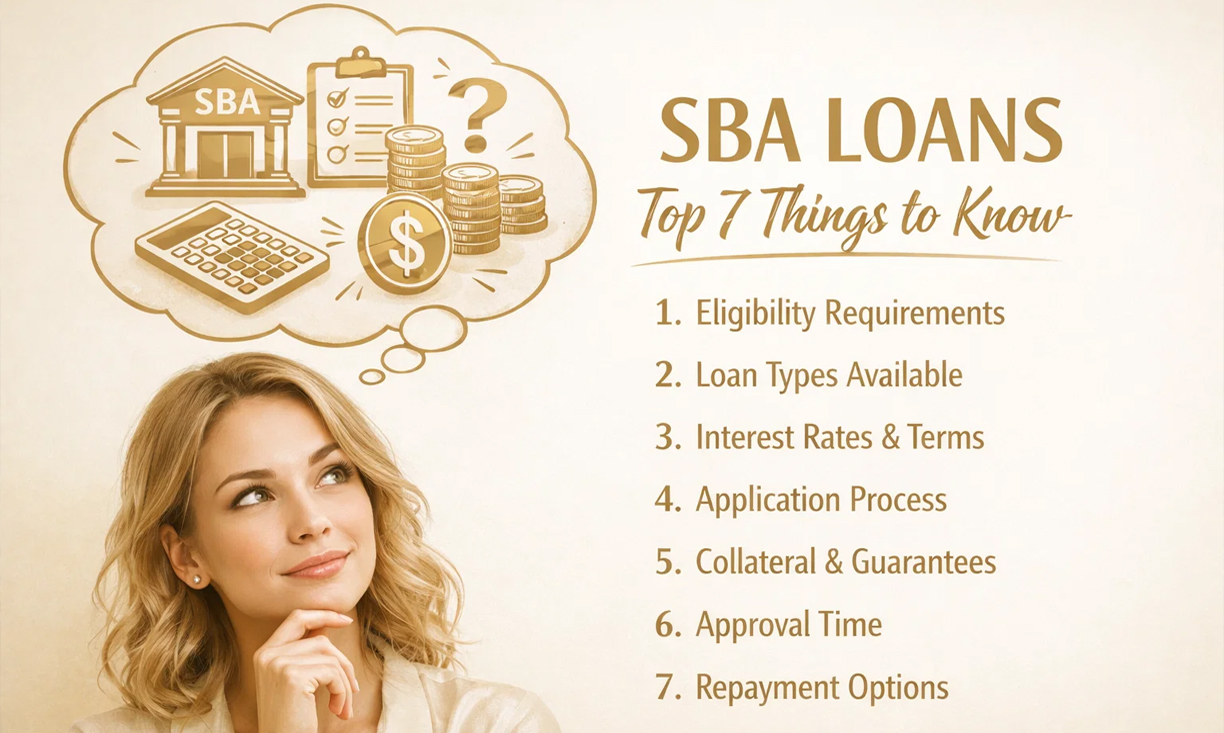
The Strategic Leverage: 7 Things You Need to Know About SBA Loans
Let’s be real: as an up-and-coming exec, your time is your most expensive asset. You don’t want a lecture on government forms; you want to know how to use government-backed capital to scale, acquire, or buy the building your company currently rents.
The SBA doesn’t actually lend you money. They act as the world’s most influential co-signer. Here is the “no-fluff” reality of using that leverage.
1. The SBA is the Shield, Not the Sword
The most common misconception is that you’re borrowing from the government. You aren’t. You’re borrowing from a private bank, and the SBA is guaranteeing up to 75% or 85% of that loan. For a C-Suite leader, this is a risk-mitigation play. Because the bank’s downside is capped, they’ll say “yes” to deals that traditional commercial credit committees would laugh out of the room—like high-multiple acquisitions with thin collateral.
2. 7(a) vs. 504: Choose Your Fighter
You need to know the difference before you walk into the room.
-
The 7(a) Loan: This is your Swiss Army knife. Working capital, debt refi, or buying out a partner. It’s flexible, but the rates are often variable.
-
The 504 Loan: This is for the “big iron”—real estate and heavy equipment. It’s structured with a fixed rate and usually involves three parties: you, a bank, and a Certified Development Company (CDC).
3. The “Credit Elsewhere” Catch-22
Here’s where it gets cheeky. To qualify, your company must demonstrate that it cannot obtain the same loan on “reasonable terms” elsewhere. This doesn’t mean you’re broke; it means you’re looking for terms—like a 10-year working capital light-amortization schedule—that the private market simply doesn’t offer. If your balance sheet is too flush with liquid cash, the SBA might tell you to use your own lunch money first.
4. The 10% Advantage
In the world of M&A, cash is king, but cash flow is God. Traditional commercial loans often demand 20% to 30% down for a business acquisition. SBA 7(a) loans frequently allow you to close a deal with as little as 10% equity. For a strategic lead, that preserved 10% to 20% of capital can be the difference between a smooth post-merger integration and a cash crunch.
5. The Personal Guarantee (The Elephant in the Room)
If you own 20% or more of the entity, you’re signing a personal guarantee. There is no “corporate veil” here. If the deal goes south, they can look at your personal assets. It’s a gut-check for many C-Suite types. However, savvy execs often mitigate this by negotiating “limited” guarantees or using life insurance policies as collateral instead of the family home. It’s a price for the leverage; just make sure you’re comfortable with the stakes.
6. Velocity is Determined by the “PLP” Status
You’ve heard SBA loans take forever. That’s only true if you pick a “Generalist” bank. You want a Preferred Lender Partner (PLP). These banks have delegated authority, meaning they make the final call on behalf of the SBA. A PLP lender can close in 45 days, while a standard bank might leave you hanging for four months while they trade emails with a government office in another time zone.
7. It’s an M&A Secret Weapon
In 2026, the cost of capital is high, and sellers are looking for exits. SBA loans allow for “Seller Note” integration. You can often use a seller’s carry-back to satisfy part of your equity injection requirement. If you’re looking to roll up competitors, the SBA program is essentially a subsidized engine for your expansion.
The Bottom Line
The SBA program isn’t a “last resort” for struggling businesses; it’s a strategic subsidy for leaders who value capital efficiency. By leveraging government-backed guarantees, you can preserve your cash for high-yield operations while the SBA helps carry the weight of your expansion. In a 2026 market where every basis point and dollar of liquidity counts, ignoring this tool isn’t just a missed opportunity—it’s poor stewardship of your firm’s growth potential.
Stop viewing the SBA as a bureaucratic hurdle and start seeing it as a competitive edge. Don’t let your next acquisition stall on the runway!
FAQs for Your Strategic SBA Loan Planning
Q1: How does an SBA 7(a) loan compare to a traditional conventional loan for a $3M business acquisition in terms of debt service coverage?
A: Generally, the SBA 7(a) will offer a longer term (up to 10 years for business acquisition) compared to the 3–5 year “mini-perm” or balloon structures common in conventional commercial lending. This longer amortization significantly lowers your monthly debt service, making it easier to maintain a healthy Debt Service Coverage Ratio (DSCR), even if interest rates remain elevated in 2026.
Q2: Can we use SBA funds if our company is partially owned by a Private Equity firm?
A: It’s complicated. The SBA has strict “affiliation” rules. If the PE firm has “control” (usually defined by ownership percentage or board control) over your company and their total portfolio exceeds SBA size standards, you may be disqualified. However, if the PE firm is a minority investor without “negative control” rights, you may still be eligible.
Q3: What are the current 2026 SBA size standards for my industry?
A: Size standards are based on either your average annual receipts or your number of employees, depending on your NAICS code. However, the SBA also offers an “Alternative Size Standard”: a maximum tangible net worth of $15M and an average net income of $5M or less after taxes for the previous two years. If you fit under this, you’re “small” in the eyes of the SBA, regardless of industry-specific caps.
Q4: How do variable rates on 7(a) loans work, and can they be hedged?
A: Most 7(a) loans are pegged to the WSJ Prime Rate plus a spread (typically 2.25% to 2.75%). While the SBA itself doesn’t offer fixed rates on 7(a), many PLP lenders can structure “swaps” or internal fixed-rate conversions after the loan is fully disbursed, though this usually comes with an added premium.
Q5: What happens to the loan if the C-Suite undergoes a transition or the company is sold again?
A: SBA loans are generally not assumable without significant jumping through hoops. If you sell the company, the SBA loan usually must be paid off at the closing of the sale. However, the 7(a) has a very friendly prepayment penalty structure (typically only applies for the first 3 years), making it an excellent “bridge” to a future exit or a larger mid-market recapitalization.
Related Posts











Recent Works


